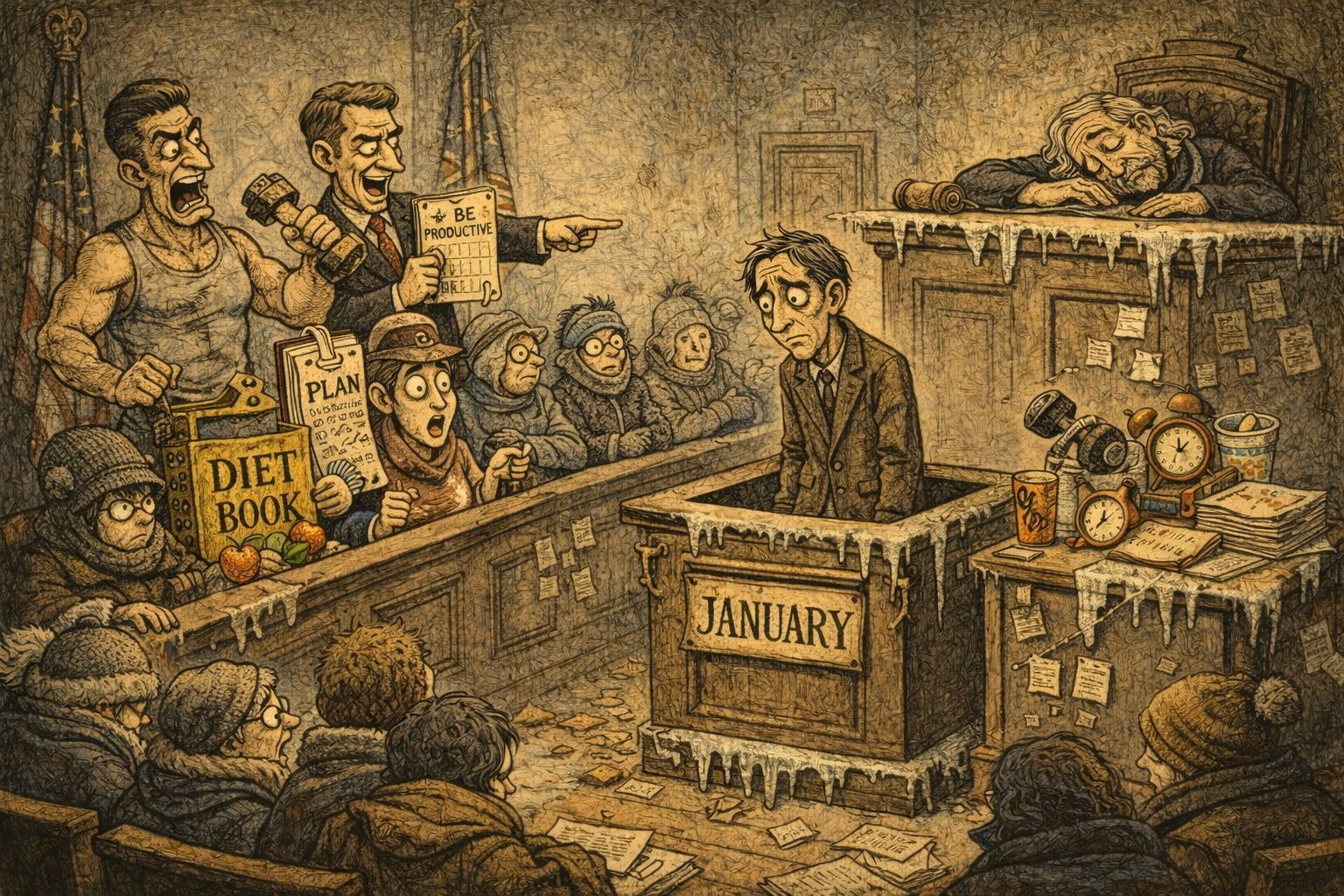
Why New Year’s resolutions fail is something most of us only really think about once we’re already feeling disappointed with ourselves. By mid-January, the motivation has dipped, the routine hasn’t stuck, and that familiar inner voice has started muttering about willpower and self-discipline again.
This article was originally written in January 2024, just after Quitter’s Day, when most people have already abandoned at least one New Year’s resolution. I’ve left the original piece largely untouched, because the argument still stands. However, at the end of the article, you’ll find a 2026 update, where I share what actually happened when I followed my own advice — including where it worked, where I misread it, and what I’d do differently if I were starting again now.
If you’ve ever wondered why January feels like the worst possible time to reinvent yourself, or why the same resolutions keep falling apart year after year, this will probably make uncomfortable sense.
Table of Contents
New Year’s Resolutions: Did You Join the Quitters Day Club?
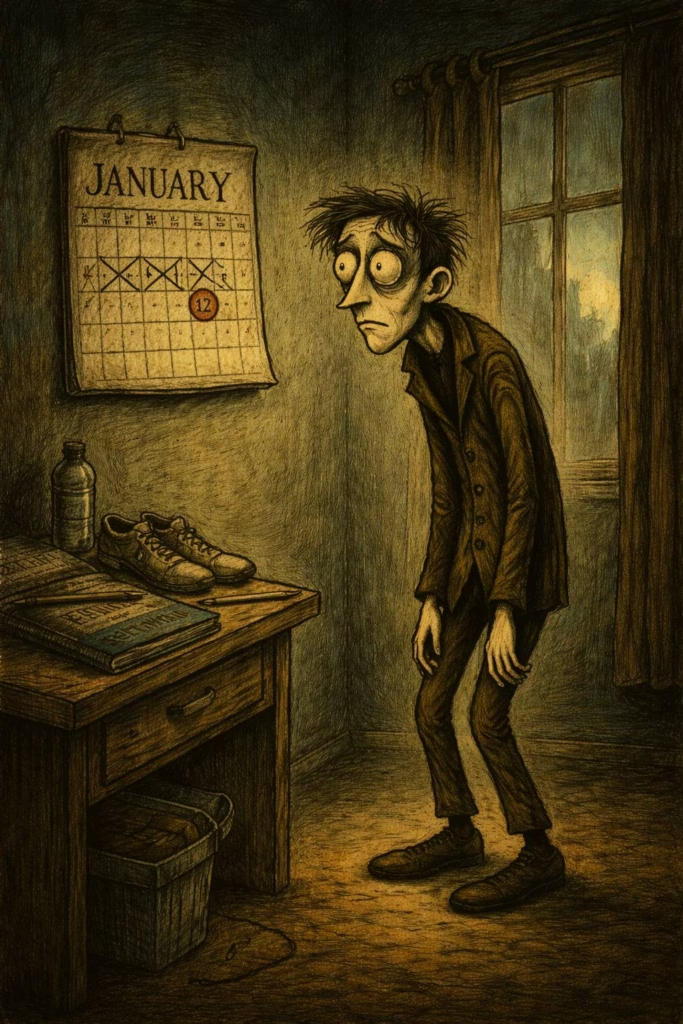
It’s not even the end of January, and you’ve already given up on your New Year’s Resolutions, you feel like a failure, and are probably wondering why this keeps happening to you year after year.
If this doesn’t ring a bell, there’s little point reading any further. You’re one of those lucky, smug gits who are good at sticking to their commitments; sincere congratulations and well done.
However, if this is you, then keep reading, and I’ll share why it might be a good idea for you to never set resolutions again and offer some alternative ideas on how to spend your time in the first couple of months of the year, as well as a better time for setting personal goals.
I originally planned to write this blog post before Christmas, but it was such a busy month at work for me that I put it off until today.
Although I hadn’t decided on the title, it was going to be something along the lines of,
“Why you should fuck those New Year’s Resolutions off”!
This could still be the subtitle of what is to follow, but the current title seems both apt and a little bit “meant to be”.
Yes, I know this sounds a bit woo-woo, but how the new title came about certainly hints at a bit of synchronicity.
Besides, woo-woo in my mind is simply an acronym for “Weird Occurrence Other’s Will Often Ostracise”, so you’re either into it, or you’re not; the choice is yours.
Weird shit is well-documented and happens all the time; the only thing debatable is the cause.
Anyway, before I go off on a tangent, let me share why I think starting to write this today (12th January 2024) is a bit more than coincidental.
Note: I don’t intend to post this until the 1st of February 2025, though.
Today is the second Friday of January and has come to be known as “Quitters Day.”
Until I fired up my PC to begin working on this post, I was not aware that there was an official day for this event or its name.
Random coincidence or spooky shit, you decide.
Some research suggests that this is the day when many people will give up on their New Year’s Resolutions, and that as much as 50% will have quit by this date.
In a UK government study conducted in 2017, 20% of respondents said they had given up on their resolutions within 6 days.
In a more recent survey, it was reported that only 31% of people who set resolutions in 2023 managed to see them all through to completion.
Therefore, 69% of people gave up on some, if not all, their resolutions at some point in the year.
The reason I’m sharing these statistics is twofold; firstly, and most importantly, to show it’s quite common to be in this position, so there’s no need to feel bad.
Secondly, to show I do actually do some research to back up what I intend to write.
Why New Year’s Resolutions Fail
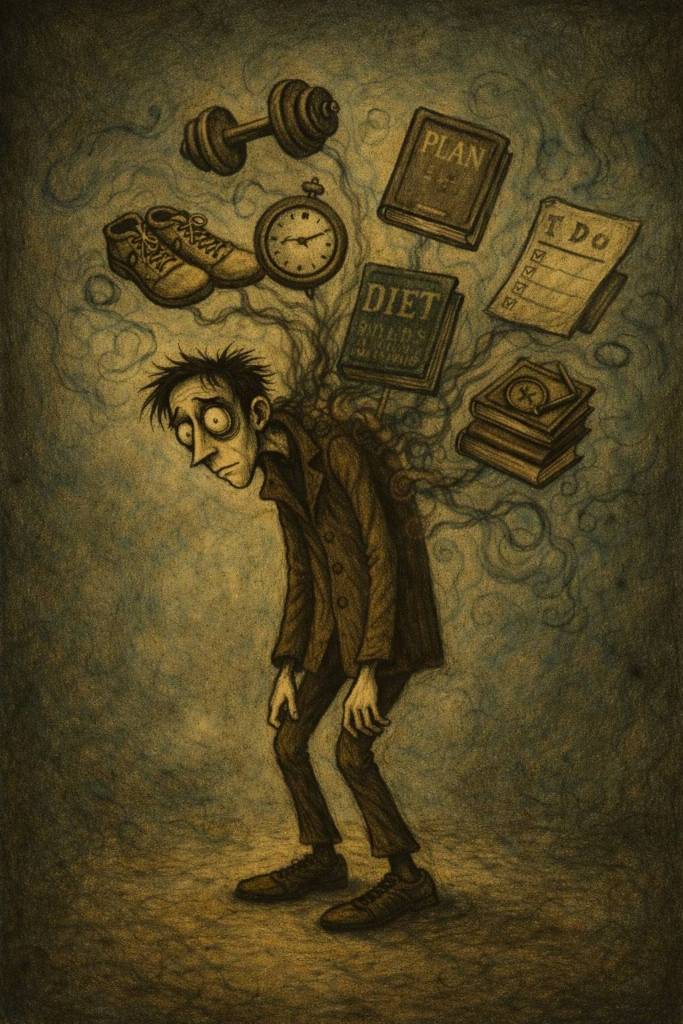
There are numerous reasons we quit quitting or stop starting, and there are, no doubt, numerous articles, blog posts, and the like that explain this too.
If this deeply interests you, go and search on Google, after you’ve finished reading this, of course, and you’ll be able to find more answers than you really need.
I’m not going to spend too long on this question because, as I just pointed out, that information is readily available from both professionals and the millions of online mimics.
Besides, for most people, knowing why you behave a certain way rarely changes a thing.
If I were to sum up all the reasons into a single sentence, it would be this:
You picked your resolution because it was something you kind of thought you should do, and part of you would really like to, but the reality is the change involves major effort, and you just can’t be arsed to do it right now because there’s no painful sense of urgency and no one is going to hold you accountable anyway.
Did reading that make you feel a little bit uncomfortable?
Did part of you agree with it, at least slightly?
If so, this post is definitely for you.
I felt uncomfortable writing it, and I haven’t even set any goals for 2024 yet.
I did in 2023, and I will talk about how this panned out later.
But for now, all you need to know is that you are not alone, and if you look back at those statistics, it’s quite a normal part of human behaviour.
The good news is that you can still make these kinds of personal changes, provided you set things up correctly to improve your chances of success.
I’ll touch on this at the end of this post.
Why Quitting New Year’s Resolutions May Be Good For You.
Firstly, I’m not talking about quitter’s day anymore.
I’m certainly not saying that being a lazy, unhealthy person is good for you either.
I only say that last thing because the top two resolutions people make are “exercising more” and “eating more healthily”.
So if you’re not exercising or eating a balanced nutritional diet, then some could call you lazy and/or unhealthy, but I’m calling you neither, just regurgitating what I’ve seen, read or heard.
Name-calling is a very juvenile behaviour and, in my opinion, should be done only with good friends who have a good sense of humour.
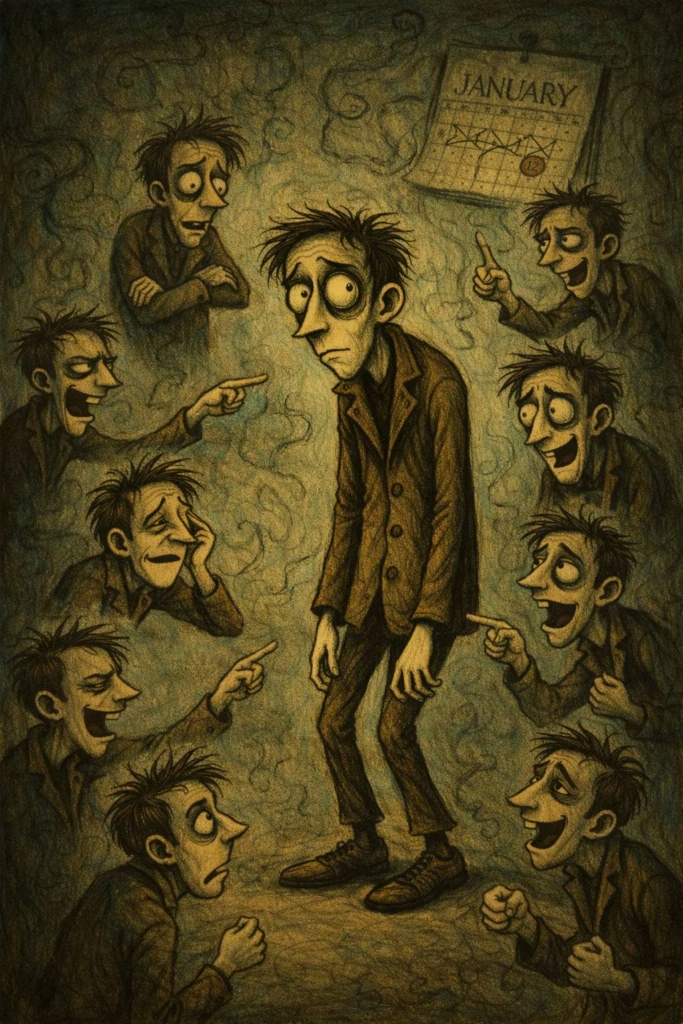
The worst critic in these instances is usually ourselves anyway.
What I‘m actually saying is NEVER make a New Year’s Resolution again.
Why would you say such a thing?
Good question, allow me to elaborate.
If you’re completely honest with yourself, you know you’re shite at sticking to these kinds of goals.
You’ve probably got years of experience in playing out a circular pattern of behaviour similar to this:
- Make a New Year’s Resolution
- Feel Excited as you begin
- Realise it’s not easy
- Get bored with it
- Look for distractions and excuses
- Lose Interest
- Return to the prior state
- Totally forget about it until December
- Promise yourself you’ll do better next year
- Rinse and repeat.
So, if you can relate to this cycle, as I used to, what makes you believe that continuing to do the same thing again will yield different results?
According to Einstein, the word that defines this behaviour is “Insanity”.
If this alone is not enough reason to ditch resolutions for good, do not fear, I have some more.
Modern Life Has Moved Faster Than Our Bodies
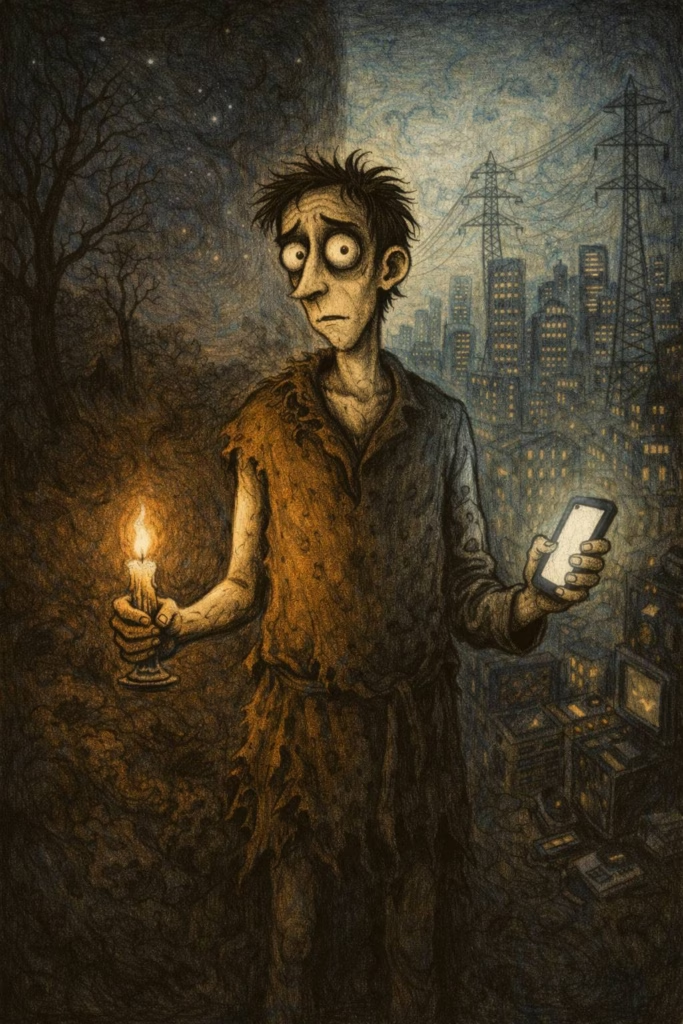
Depending on your age, there will be certain technologies you take for granted and expect to always be there, others that seem amazing, and others that may evoke a nostalgic sense of awe.
For example, at the time of writing, the potential of AI is pretty much universally amazing, regardless of age.
If you are 20 or under, things like Facebook, Amazon & Broadband Internet have been there for your entire memorable life and are therefore taken for granted.
People over 30 will remember the days of dial-up Internet connections, having to leave the house to buy anything, and a time when there was no such thing as social media.
These people still take these things for granted, but at least recognise that they were life-improving technologies if they sit and think about it.
Some may argue, did they really improve life? The short answer to that is “yes, but…”
Irrespective of age, one piece of technology most people can take for granted is electricity in the home; you’re unlikely to be reading this if you don’t have it.
Whether you can currently afford to use much of it is another matter.
Few people, if any, will remember living in a house without it.
However, as far as the history of our species is concerned, it is quite a modern phenomenon.
To illustrate, the first public electricity generator in Britain was installed in Godalming, Surrey, in 1881.
Where are you going with this, Mr Welbourn?
Stick with me, we’re getting there, I assure you.
So, prior to having electricity in the home, light would have been provided by flame, whether an open fire, candles, oil lamps, or, for a short period, gas lighting.
A bit like today, unless you were really wealthy, you would have been conservative with your use of the available technology.
If, like me, you’re a bit of a night owl, a couple of hundred years ago, you would probably have been reading a book dimly illuminated from the dying embers of a fire.
However, most people would have gone to bed a few hours after dusk, slept for a few hours, then woke for a couple of hours before having a second sleep until near dawn.
Obviously, in the summer this would mean less sleep & in the winter much more, depending on your location.
For those interested, this double sleep pattern is called biphasic sleeping. Click the link to read a study on the subject.
As interesting a subject as this is, the main thing I want to convey is that we, modern humans, are heavily out of sync with our natural tendencies; technology has evolved much more quickly than our bodies have.
Whether adopting this sleep regime would be practical is worth further study.
It is my current belief, though, that at the time of year when the days are shortest, we would be wise to kind of hibernate, so as to allow our minds and bodies to rest and recuperate, ready for the spring.
We should follow the examples set by the rest of nature; we are part of it after all.
It certainly is not the best time to start a new exercise regimen for many people.
Seasonal Affective Disorder
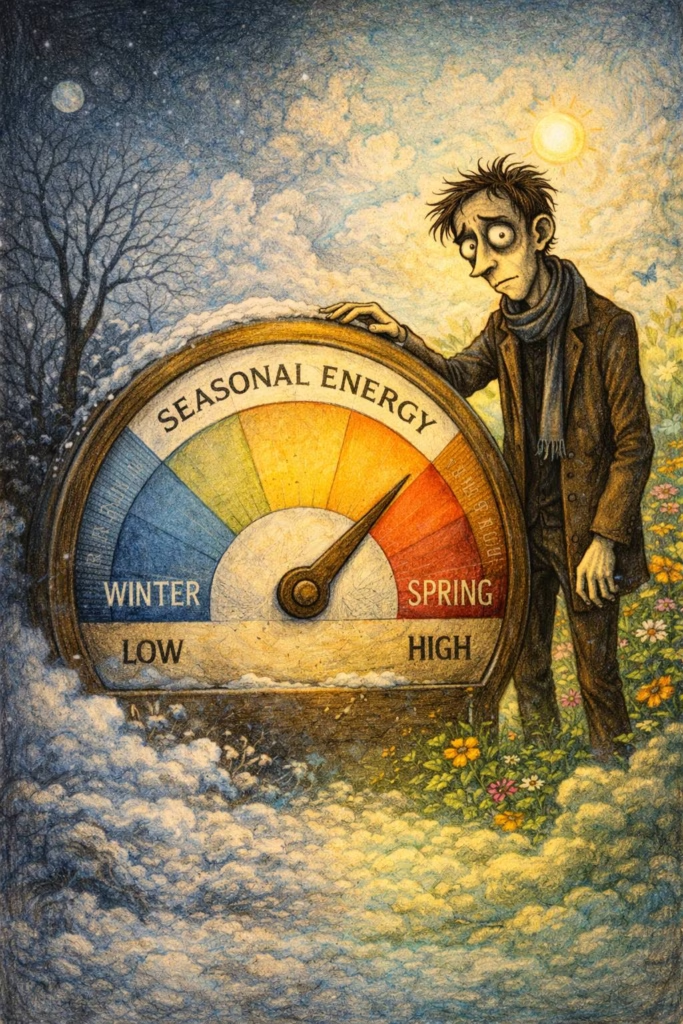
It is suggested that a lack of sunlight causes this condition.
The severity and number of the symptoms may vary, but low energy is pretty much universal.
I first noticed this in myself around a decade or so ago, although it could have been present for much longer.
The reason I noticed it when I did was that I was in a phase of very high productivity, and generally speaking, in the summer, I had been getting along fine with around 5 hours of sleep a day.
However, as the days grew shorter, I noticed my productivity decreased, and the amount of sleep I needed to function well increased.
This was no good; I had shit to get done, so I tried to fight it, but my body had none of it.
I’d just end up getting irritable with myself and others.
Over the next couple of years, I tried various recommendations to combat this annoyingly repetitive annual event, such as SAD lights, supplements, and spending more time outside, but my energy levels still plummeted in the winter.
For a little while, I entertained the notion that it was “just a sign of getting older”, but that’s just bollocks; the energy always returned in the spring.
For a few years, I just accepted that this is the way it is unless I want to be put on some medication, which I don’t.
I have since come to see it as the body just doing its natural thing.
I was discussing this recently while walking with a friend I used to work with at a Health Centre.
I was mentioning how I usually say to people I suffer from SAD in the winter, but how I was now of the mind that it is not a disorder but…
Before I could finish my sentence, he finished it with “something natural”.
We then discussed at length the various ways we are out of alignment with nature these days.
One thing of significance which changed in my mind on this day was that I was no longer thinking I had a disorder.
I don’t know anyone who feels good when they think to themselves, “Hey, I have a disorder” This just reinforces the idea in your unconscious.
On the other hand, I know hundreds of people who felt great after overcoming one.
OK, it’s just a bit of reframing that’s gone on in this case, but reframing can be very powerful psychologically when used right.
For those still reading, hopefully you’re starting to see why I really think setting goals in January is a bad idea; do you agree with me yet?
Not sure?
Let me convince you further and add some weight to this argument, so you don’t think it’s just the ramblings of some mad fool and his friend.
I’m going to share some thoughts from an author and philosopher from over a hundred years ago…
Prentice Mulford

In a Podcast I currently run every Monday, I read a Chapter from a Personal Development book in the public domain and then share my thoughts at the end.
Towards the end of 2023, I was going through Thoughts are Things by Prentice Mulford, written around 1889. (Note: Podcast no longer running. I now host one discussing spirituality with an Indigenous friend from America.)
Here are three quotes from Chapter 10 in his book, which I think are relevant to our topic:
1.“During the later winter and earlier spring months, you are “moulting.” You are casting off old, dead matter, and taking in new, providing you give this force opportunity to act on you to the best advantage, by ceasing to be active either with mind or body when they call for rest, as do birds and animals during their moulting period, or process of casting off the old elements and receiving the new.”
2.“The Indian called February and March the “weak months,” recognizing, as he did, being a closer observer of nature than we, the tendency to sluggishness and inactivity in animal and man, which always prevails when this power is recuperating, and renewing any organized body.”
3.“The most perfect crystallizations out of mineral element come of the solution kept most free from agitation. Your body is governed by the same law in this spring renewing and recrystallization of its elements. To receive the fullest benefit of the heating and renewing element of spring, you should rest whenever you feel like resting, whether it be the middle of the day or the middle of the night. If you keep the body or mind at work against their inclination – if you force your muscles to exertion through mere strength of will – if you work with either mind or body to the verge of utter exhaustion, not knowing how depleted you are of strength until your work is over, as thousands on thousands do and are compelled to do, through our unnatural system of life and the arbitrary demands of “business,” you prevent this healing and recuperative power from acting to its fullest extent on the body.”
He has much more to say on the subject in this chapter, but hopefully you’re coming to see things differently now and are all but convinced that what I am saying is a damn fine idea.
Origins of New Year’s Resolutions
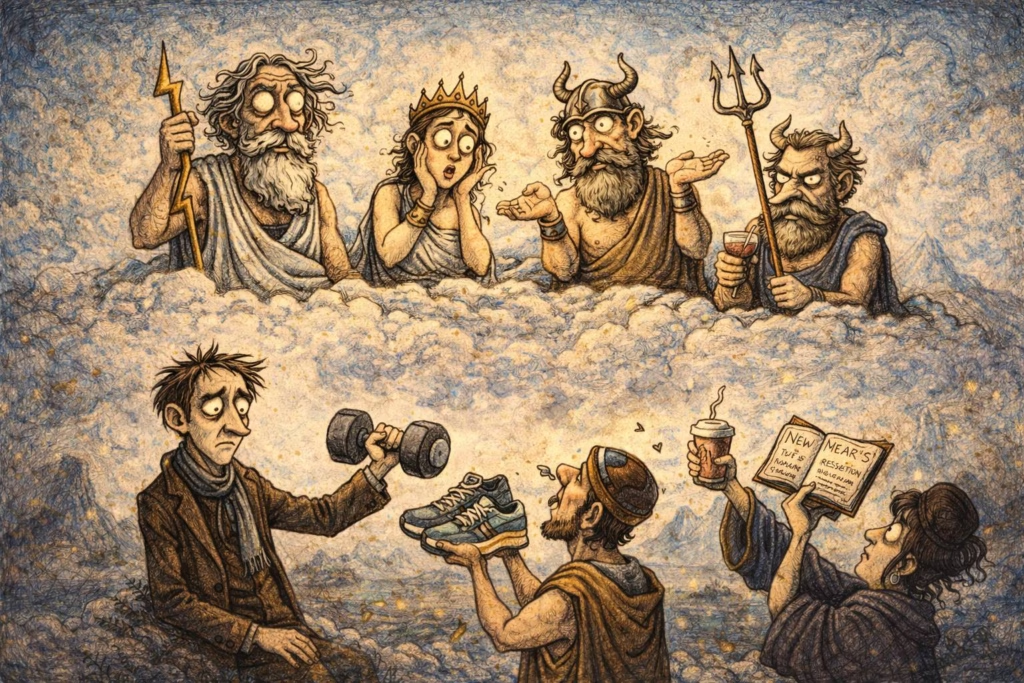
Historians say this practice dates back 4,000 years to the Babylonians, who held a 12-day festival in mid-March.
It was Julius Caesar who is responsible to some extent for our New Year beginning in January, but it was not adopted here in the UK until many centuries later.
Ironically, he was assassinated in March on what was originally the Roman New Year!
Check out 26 alternative dates for New Year from around the world.
Until more recent times, resolutions were of a Religious type in the sense of making some sort of promise and offering to the Gods and Goddesses, or to God.
Although the idea has been around for a long time, starting a new exercise regimen in winter is a relatively modern phenomenon.
How to Spend the First Quarter of the Year

It’s a common thing to believe our lives are “too busy” today to take some time off from the world, but is that really true?
Only you can answer the question for sure, but if you are reading a post like this, I almost guarantee that if you were to record your daily activities hour by hour, you would find that a hell of a lot of your time is spent on pointless distractions.
Just a quick side note: whilst it can certainly be said there are more things vying for our time now than at any point in history, putting things off due to distractions is nothing new.
I recently listened to the audiobook version of the Discourses by the Stoic philosopher Epictetus, and he mentioned that the Romans acted in this manner.
What the hell were they distracted by?!
Anyway, back on point.
Not many of us would be able to retreat from the chaos of worldly life for a few months, as we do have certain commitments we can’t simply walk away from.
But if you are someone who could, I suggest you should.
For the rest of us, what I suggest instead is that you do the bare minimum of activity that you can get away with; I mean this physically & mentally.
If there are days when you don’t need to set an alarm to get up, then don’t; simply wake up when your body naturally wants to.
If you feel like sleeping not long after sunset, you might want to see if biphasic sleep works for you.
If it doesn’t, either a power nap or getting up early could be the answer.
The main takeaway is this:
Listen To What Your Mind And Body Are Telling You It Wants And Do It.
Cut out things which cause you stress and do things which make you feel good.
If binge-watching a TV show actually makes you feel good, then do it.
You’ll still have 9 months of the year to plug back in and get shit done.
However, there’s a good chance you’ll have more energy to do it and see it all through to completion if you take some “me time” first.
Review and Rethink
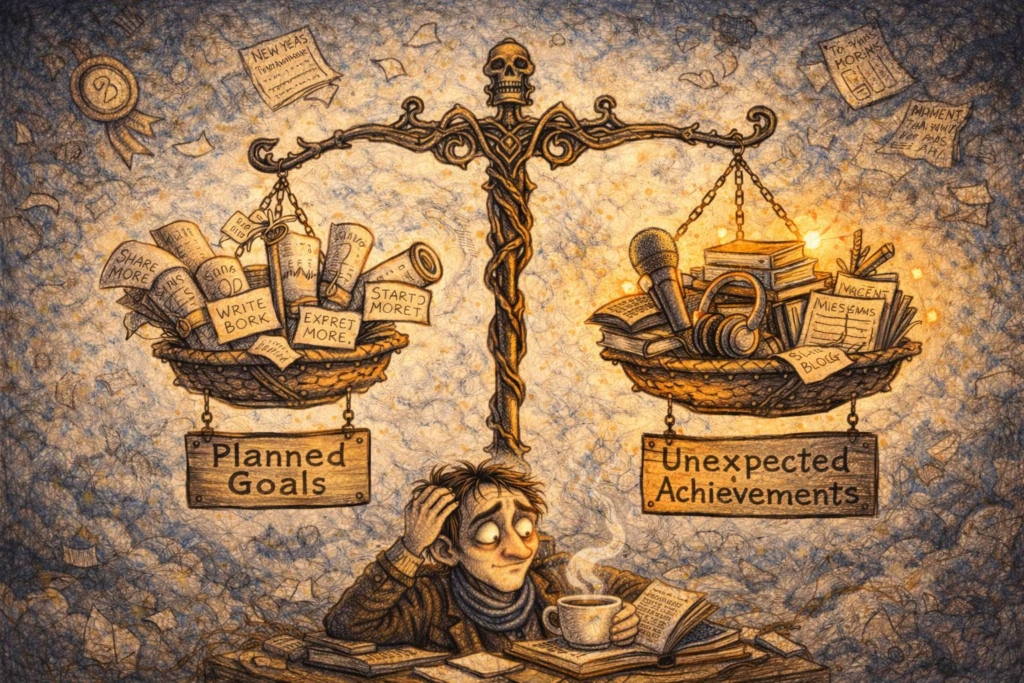
Another thing I think would be a good idea during this recuperation time is to review your previous year.
Look at what you thought you would achieve, what you didn’t, and also what you actually achieved.
The things you thought you’d do perhaps aren’t as big a priority as you believed.
Are they likely to be a priority this year?
Don’t decide now; just contemplate the activity and what it means to you.
What things did you do which you hadn’t initially intended to do, but upon reflection were better achievements than those you had planned?
Did you try to take on more than you actually realistically could?
What trivial things did you do which you wish you hadn’t?
When thinking about this question, imagine you only have 12 months to live.
What things would you definitely not do during this time?
This should answer the first question.
Personal Example
Whilst I haven’t set New Year’s Resolutions as such for a long time, I have set goals in one form or another for over 15 years.
I did stop for a couple of years but started again in 2023.
I will share a quick summary reflection on these goals, which I set in January:
- I created 8 categories of goals, ranging from business to health
- I then picked 3 targets for each category (one had 4 in), which gave me a total of 25 goals to achieve in 2023.
- I printed the list off & stuck it on the side of my PC with the intention of reading it every day; I didn’t!
- I didn’t share these goals with anyone.
- I didn’t use any of the techniques I know connected with goal completion.
- I didn’t select any one of them to start on and see through to completion
- Basically, I forgot all about them.
- I completed only 2 of these goals & kind of did a bit of a couple more!
At first, looking at these facts, it was kind of depressing, but by spending a bit of time reflecting on what I actually did, things weren’t as bleak as I initially thought.
Some of my business priorities had changed halfway through the year.
Some opportunities arose which I could not have seen coming.
Some of the things on the list were more of the “I really should do that” kind.
One thing I’m quite chuffed with is the fact that since signing up for Audible in July, I have digested over 20 books.
I used to do this with physical books, but have probably only read 3 a year over the last 5 years.
OK, there were still things which I wanted to do, but didn’t:
I intended to share more “useful shit” online than I actually did.
The whole point of being a bit of a studyaholic is to assimilate knowledge and pass it on to others.
One way I hoped to achieve this was to run a podcast focused on my own ideas about personal development.
I did this for, I think, 8 episodes, but I wasn’t happy with them, so I deleted them all.
Towards the end of the year, I decided to start a blog, but this is only the second post.
On this, I will do better; that is about all I want to put out as a goal for 2024 at this point.
The most frustrating thing I did not complete was my second book.
In an ideal world, I’d just write it and put it out there, and it would be scooped up.
This is not reality, I know that, and there are many other annoying things you have to do first.
So I guess that is another goal for 2024… probably!
I am taking my own advice and not setting anything in stone; it’s still January.
What to Do Now
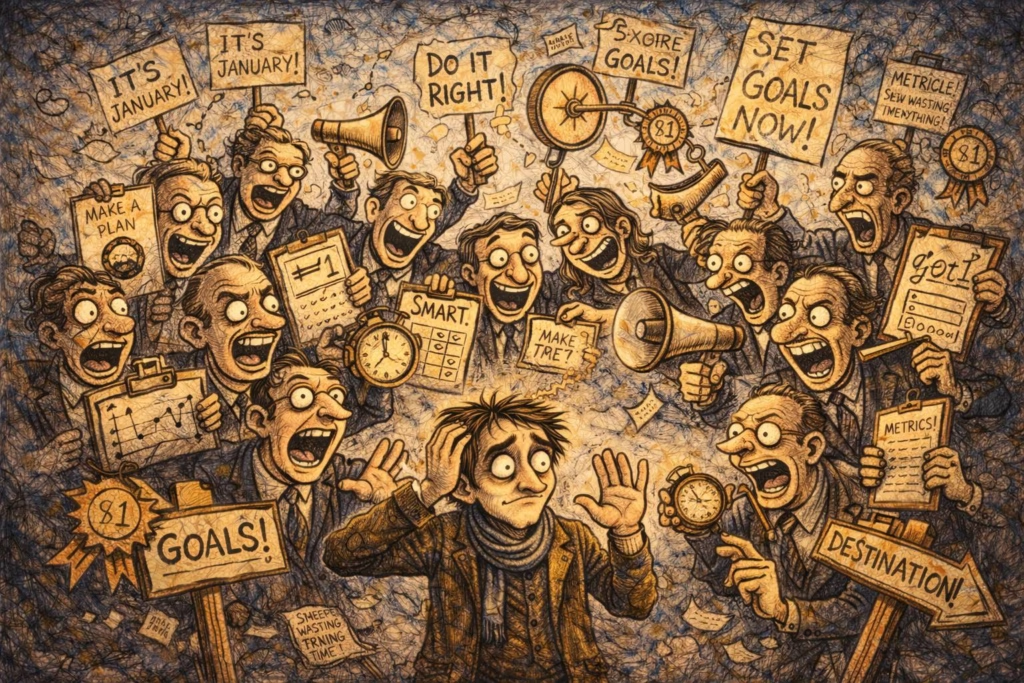
Ok, this has been a long post, and the end is in sight.
Thanks for sticking with me this far.
I’m hoping I have put forward a good argument for why you should no longer set New Year’s Resolutions, and why you shouldn’t feel bad for not achieving them in the past.
The choice is always yours, of course.
If you still want to have a crack at goal-setting in January & February, there are an absolute shit ton of people online offering suggestions on how to do it right now.
Here are a few things to consider when goal-setting:
1. Be realistic and don’t aim to do too much too soon.
2. Set recognisable milestones to guide you from where you are now to where you want to be.
3. Get a trusted confidant whom you will report your progress to and who will offer you encouragement.
4. Set a consequence for failure which is painful (not physically).
5. Set a reward for successful completion.
However, I recommend waiting until the end of March before even committing to any specific goals.
2026 Update/Caveat

In 2024, I followed the advice I outlined in this article, but went too far with “not doing too much” in the first 3 months of the year. After a couple of weeks, I got it into my head that there was no rush to start even the light work, such as planning. Before I knew it, it was the end of March, and I had done F.A. I had slowed down too much, and it took me almost a full month to get my motivation and output up to full speed.
However, in 2025, I still avoided doing too much in January and February while maintaining momentum. I had just finished the first draft of my second book, so I spent much of this time on tasks which didn’t require a lot of physical exertion, editing, checking for cock-ups, and, most tedious of all, correcting grammar and formatting. It’s Not Ok to Be Not OK was published at the start of April, and my output for the rest of the year was beyond anything I had done for many years.
So, my caveat to the advice in this article is: if you’re incredibly wealthy, then yeah, taking the start of the year off may well work for you.
But, if you are not in the top 1-5% of wealthy people, then my New Year’s advice is this:
Find a pattern that actually works for you. You don’t want to burn yourself out at the start of the year, but you also don’t want to come to a full stop. You are not in competition with the gym bunnies, the high achievers, or any other fucker. If you are going to implement a “change”, be certain it will fit your current lifestyle and priorities, because if it strays too far from your usual life, odds are not in your favour.
Momentum beats motivation every time, but only if it’s built around the life you actually have, not the one you think you’re supposed to want.